there’s a meme that goes around the internet every few months: “ i love asking kids what they want to be when they grow up, because i’m still looking for ideas.”
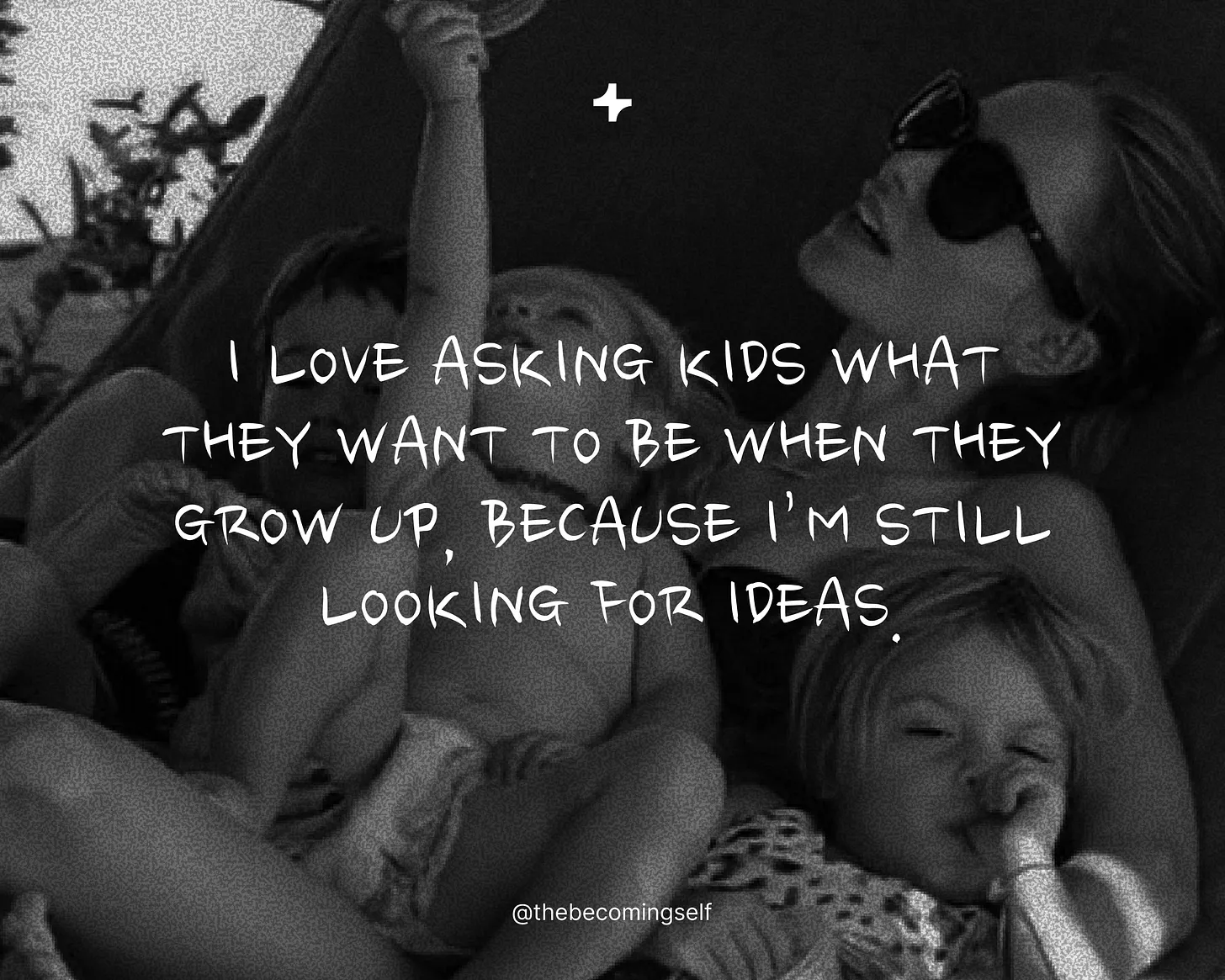
it always goes viral. people quote it, screenshot it, and send it to the group chat. and every time it surfaces, i think the same thing: this is one of those memes that works because it’s not really a joke. it’s a confession covered up as a punchline. we laugh at it because laughing is easier than admitting we assumed the question had an expiration date, but it didn’t.
at some point, everyone has been asked: “what do you want to be when you grow up?”
this is a question meant for children. the idea is that there’s a moment — in our 20s, maybe — when we find a definitive answer for it, the answer will stick, and we’d be set. and you become an adult in society when you can answer this question quickly and concisely in a word that everyone will understand. i’m a lawyer, a doctor, a teacher…
but the meme is funny because we all know this is no longer true, at least not for most.
when i was around 12 yo, i had it clear, i wanted to become an architect. i could barely define what they did, so i asked around, googled it, and started researching books and magazines until the identity became clear.
don’t think it was that easy. i wasn’t a good student at all, especially if we talk about maths. but somewhere between denial and determination, made me keep persuading this path. until at 18, it became a reality, i entered architecture school almost by miracle, but when i did, it was like arriving in heaven. all conversations about creativity, design, and architecture. it was so unreal, i obsessed about it, it was my place until it wasn’t.
i had spent years building an identity around becoming an architect — the way i talked about buildings, the books i read, the way i dressed, the kind of person i became working at three in the morning. architecture wasn’t something i was studying. it was who i was. and then one day it wasn’t, and i had to sit with the fact that i had no idea who i was without it.
what followed was the kind of identity crisis that doesn’t have a clean name. not depression exactly, not a quarter-life cliché, just a long, quiet period of not knowing how to answer the most basic question anyone could ask me at a dinner. so what do you do? i had been so good at being an architect-in-training that i’d never noticed i was answering the wrong question my whole life.
because here’s what dropping out taught me.
i hadn’t lost my identity. i’d lost the answer to that question; society pressures you into defining. and the tag (architect, lawyer, doctor…) had been doing all the work of pretending to be an identity, which is why losing it felt like losing myself in the trade. if you build yourself on a tag, you are exactly as durable as that tag. when it vanishes, you disappear with it.
i notice this same trap everywhere now, at every stage of life.
the 17 year-old being asked to choose a degree before they have explored all the options, while everyone around acts like this is a normal thing to know for a person who has not yet lived alone or held a full-time job or, really, in any meaningful sense, met themselves.
the 28-year-old with adhd who has been called scattered their whole life, who has started and abandoned more projects than they can count, who is finally beginning to wonder if the problem was never their inconsistency but the fact that no single tag was ever going to define them. it doesn’t need a career. it needs a different question.
the 52 year-old who built a 25 year career inside one company, one industry, one version of himself, and just got walked out of the building with a severance package. he is not having a midlife crisis. he is discovering, late, that he was never the job. the job was the costume. and now the costume is gone, and he has to figure out what’s underneath it for the first time in his adult life.
different people. same unanswered question*.* same trap.
the trap is this: what do you want to be is a question about circumstance.
it depends on the economy, on your abilities, on luck, on timing, on whether the industry you’ve poured yourself into still exists in 10 years. it is a brittle question to build a life on, because everything it depends on is outside you.
who do you want to become is a different question entirely.
it is about the kind of person you are practicing being. the values you are sharpening. the way you treat the people in front of you. the standards you hold yourself to when no one is watching. the texture of your attention, your taste, your judgment. none of this is circumstantial. none of it can be made redundant by a layoff, a market shift, or a dropout.
the what will change for all of us, more times than we expect.
the who is the only thing you actually get to keep.
this is the reframe that pulled me out of the crisis after architecture, though i didn’t have the language for it then. i stopped trying to find a new what to replace the old one. i started, slowly and badly, to pay attention to who i was becoming through the things i chose to do. the work i took on stopped being about a title and started being about whether it was sharpening or dulling the person i wanted to be.
i don’t think this is a clever idea. i think it’s an obvious one that almost no one is taught. we are taught to answer the kid’s question, and then we are mocked for still not having an answer at 40. no one tells us the question was wrong.
this space is about the other question.
not about finding your purpose, or your passion, or any of the other words that have been worn smooth by self-help. about the slower, less glamorous work of paying attention to who you are becoming, and getting better at choosing it on purpose.
the art of becoming — because it is an art, with curation and taste and practice, not a formula you complete once and file away.
i have been working on this for myself for about six years. i don’t have it figured out. that’s part of why i’m writing — because the work doesn’t end, and writing through it is how i think.
if you are still looking for ideas about what you want to be when you grow up, i’d gently suggest you might be answering the wrong question. the one underneath it is harder, and better, and the one i’ll be writing about here.
i’m glad you’re here.